More than just the home of the President, the White House in Washington, D.C. is a renowned symbol of the President, of the President's administration and of the United States.
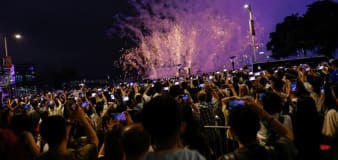
As the nation's capitol, it is no wonder that Washington, D.C. showcases one of the most spectacular firework displays in the country on Independence Day.
Getty Images
M Street in Georgetown, jammed-pack with trendy shops and restaurants, is one street in Washington, D.C. that is full of hustle and bustle at any time during the day.
Getty Images
George Washington's Mount Vernon Estate and Gardens - Washington, D.C.
Mount Vernon is the most popular historic estate in America and is open 365 days a year. Mount Vernon does not accept grants from federal, state or local governments, and no tax dollars are expended to support its purposes. Primary sources of income are revenue from the retail and dining facilities, ticket sales, and donations from foundations, corporations, and individuals.
The estate, gardens and farm of Mount Vernon totaled some 8,000 acres in the 18th century. Today, roughly 500 acres of this historic estate have been preserved 16 miles south of Washington, D.C., on the banks of the Potomac River. Visitors can see 20 structures and 50 acres of gardens as they existed in 1799. The estate also includes a museum, the tombs of George and Martha Washington, Washington's greenhouse, an outdoor exhibit devoted to American agriculture as practiced by Washington, the nation's most important memorial to the accomplishments of 18th-century slaves, and a collection which features numerous decorative and domestic artifacts. Mount Vernon welcomes an average of 1,000,000 visitors each year.
Mount Vernon
Main Reading Room of the Library of Congress. Washington, D.C. - photo by Michael Dersin
Michael Dersin, Library of Congress
Holocaust Memorial Museum. Washington, D.C.
Holocaust Memorial Museum
Hirshhorn Museum - Washington, D.C.
The Smithsonian Institution?s Hirshhorn Museum and Sculpture Garden welcomes visitors at all levels of understanding to experience the transformative power of contemporary art. The museum collects, preserves, and presents international modern and contemporary art in all media, distinguished by in-depth holdings of major artists of the twentieth and twenty-first centuries. By collaborating with artists on exhibitions, programs, and special projects, the Hirshhorn provides an important national platform in Washington, DC for the vision and voices of artists. The museum is open daily from 10 am to 5:30 pm (closed December 25) and is located at Independence Avenue and Seventh Street SW; admission is free.
Hirshhorn Museum and Sculpture Garden
International Spy Museum. Washington, D.C.
The International Spy Museum opened in Washington, DC on July 19, 2002. It is the only public museum in the United States solely dedicated to espionage and the only one in the world to provide a global perspective on an all-but-invisible profession that has shaped history and continues to have a significant impact on world events.
The Museum features the largest collection of international espionage artifacts ever placed on public display. Many of these objects are being seen by the public for the first time. These artifacts illuminate the work of famous spies and pivotal espionage actions as well as help bring to life the strategies and techniques of the men and women behind some of the most secretive espionage missions in world history.
International Spy Museum
More than just the home of the President, the White House in Washington, D.C. is a renowned symbol of the President, of the President's administration and of the United States.
Getty Images
The National Museum of the American Indian - Washington, D.C.
The National Museum of the American Indian is the sixteenth museum of the Smithsonian Institution. It is the first national museum dedicated to the preservation, study, and exhibition of the life, languages, literature, history, and arts of Native Americans. Established by an act of Congress in 1989 (amendment in 1996), the museum works in collaboration with the Native peoples of the Western Hemisphere to protect and foster their cultures by reaffirming traditions and beliefs, encouraging contemporary artistic expression, and empowering the Indian voice.
The National Museum of the American Indian
National Gallery of Art - Washington, D.C.
The East Building's Tennessee pink marble taken from the same quarries that provided stone for the West Building has a dramatic glow after dark.
Dennis Brack/Black Star
Dennis Brack, Black Star / National Gallery of Art
National Air and Space Museum. Washington, D.C.
The National Air and Space Museum on the National Mall in Washington, D.C. has hundreds of original, historic artifacts on display, including the Wright 1903 Flyer; the Spirit of St. Louis; the Apollo 11 command module Columbia; and a Lunar rock sample that visitors can touch.
The Museum offers 22 exhibition galleries, the Lockheed Martin IMAX Theater, flight simulators, a three-level Museum shop, and a food-court-style restaurant. Docent tours, daily free educational programs, and school group tours and activities are also available.
National Air and Space Museum
The Phillips Collection - Washington, D.C.
The Phillips Collection is "an intimate museum combined with an experiment station." Duncan Phillips, 1926.
The Phillips Collection is an exceptional collection of modern and contemporary art in a dynamic environment for collaboration, innovation, engagement with the world, scholarship, and new forms of public participation.

The Phillips Collection
National Museum of American History. Washington, D.C.
National Museum of American History
Newseum - Washington D.C.
Newseum Blends High-Tech With Historical:
The Newseum ? a 250,000-square-foot museum of news ? offers visitors an experience that blends five centuries of news history with up-to-the-second technology and hands-on exhibits.
Sam Kittner, Newseum
United States Botanic Garden - Washington, D.C
Steeped in history, rich with tradition, the United States Botanic Garden (USBG) is one of the oldest botanic gardens in North America. It informs visitors about the importance, and often irreplaceable value, of plants to the well-being of humankind and to earth?s fragile ecosystems. The Garden highlights the diversity of plants worldwide, as well as their aesthetic, cultural, economic, therapeutic, and ecological significance.
United States Botanic Garden
United States Capitol building. Washington, D.C.
US Capitol
Corcoran Gallery of Art - Washington, D.C.
In the words of its founder, the Corcoran is ?dedicated to art.? Its museum presents, interprets and preserves the art of our times and of times past; its college of art nurtures and helps shape new generations of artists and designers. Education is a central focus, not just in the Corcoran?s classrooms but in its galleries and throughout the greater Washington region. Though American art is the collection?s emphasis, the art of other nations and cultures is, when appropriate, acquired and exhibited.
Corcoran Gallery of Art
The National Zoo - Washington, D.C.
We are a 163-acre zoological park set amid Rock Creek Park in the heart of Washington, D.C. Open to the public 364 days a year, we are home to 2,000 individual animals of nearly 400 different species. Our best known residents are our giant pandas, Tian Tian and Mei Xiang.


The Zoo is one of Washington's and the Smithsonian's most popular tourist destinations. Welcoming up to two million visitors?from the local community, the country, and the rest of the world?every year, free of charge.
Jessie Cohen, Smithsonian's National Zoological Park